Shayna Jack: A Story of Resilience, Speed, and Triumphs
If you closely follow international swimming, the name Shayna Jack instantly sparks conversations about sheer speed, undeniable talent, and an unbelievable level of personal resilience. You do not just become a world-class sprinter overnight. It takes years of waking up before dawn, staring at the black line at the bottom of the pool, and pushing your body beyond its natural limits. Shayna Jack represents the pinnacle of this dedication. When we look at the landscape of modern swimming, her journey stands out as one of the most compelling narratives in the sport. It is not just about the gold medals hanging around her neck; it is a profound testament to overcoming adversity, navigating immense public pressure, and fighting relentlessly to clear her name and return to the water. In competitive swimming, where races are decided by hundredths of a second, the mental game is just as grueling as the physical one. We are going to explore exactly what makes this Australian powerhouse tick, how she rebuilt her career from the ground up, and the technical brilliance behind her explosive freestyle stroke. Prepare to understand the true grit required to conquer the Olympic pool and the daily sacrifices required to maintain a position on top of the podium.
The Core Impact and Value in the Pool
The core of her success lies in her unique approach to freestyle sprinting and her unmatched value in team relays. When an elite swimmer steps onto the blocks, they bring a specific value proposition to their national squad. For the Australian Dolphins, having a reliable, explosive sprinter is simply non-negotiable. Let us look at the immense value proposition she brings to the competitive arena. First, her relay takeover times are legendary. A relay is not just about flat speed; it is about the transition. Anticipating the touch of a teammate and leaving the block with a reaction time of just 0.03 or 0.04 seconds is an absolute art form that can win or lose a gold medal. Second, her ability to anchor a race—absorbing the immense pressure of trailing competitors and holding off the field—makes her a linchpin for international success.
Read also: Millie Boyle: Career Stats and Pro Journey; Ariarne Titmus Guide To Freestyle Swimming Excellence; Master the Savo Dokić System Today.
| Competition Level | Event Focus | Impact and Result Profile |
|---|---|---|
| World Aquatics Championships | 4x100m Freestyle Relay | Consistent anchor or crucial middle leg, securing World Record times and gold medals. |
| Olympic Games | 50m & 100m Freestyle | Top-tier finalist, executing high-pressure performances against the best global rivals. |
| Commonwealth Games | Mixed Relays & Individual | Multiple medal hauls, completely dominating the regional and global Commonwealth stage. |
To really understand how she maintains this level of elite execution, we have to look at the three critical pillars of a championship-level swimming regimen.
- Explosive Dryland Power: Elite sprinters do not just swim; they lift extremely heavy weights. Squats, deadlifts, and plyometric box jumps build the massive leg drive required for a thunderous start off the blocks and incredibly fast turns off the wall.
- High-Intensity Interval Training (HIIT) in Water: Instead of logging endless, slow kilometers, the focus shifts to ultra-high intensity, low-rest sets. Think max-effort 25-meter dashes that train the central nervous system to fire fast-twitch muscle fibers efficiently.
- Unwavering Mental Conditioning: The pressure of the ready room can easily break an athlete before they even see the water. Working with sports psychologists to develop tunnel vision and block out external noise is a fundamental requirement for survival at the elite level.
Early Origins in the Pool
Every champion starts somewhere, and for most Australian swimmers, the journey begins in local club pools under the scorching summer sun. From a very young age, she displayed an unnatural affinity for the water. The early origins of her career were marked by a rapid and exciting ascent through the junior ranks. Coaches quickly noticed that she possessed a rare combination of natural buoyancy, an exceptionally high stroke rate, and a highly aggressive racing mindset. While other kids were learning the slow basics of long-distance endurance, she was already naturally gravitating toward the explosive, high-octane world of sprinting. Junior national titles soon followed, setting the perfect stage for a highly anticipated senior debut.
The Evolution of a Sprint Champion
The transition from a talented junior to a senior international competitor is exactly where many athletes falter, but this is exactly where the evolution of a champion took place. Breaking into the Australian national team—arguably the most competitive freestyle roster on the planet—requires swimming times that would easily win national titles in almost any other country. She had to meticulously refine her technique, dropping the wide, looping arm recovery of her youth for a straighter, more biomechanically efficient recovery. This era of her career involved intense biomechanical analysis, optimizing her head position to reduce frontal drag, and perfecting her underwater dolphin kicks to maximize the speed generated off the starting block.
Modern State and Recent Olympic Success
Looking at the modern state of her career, especially reflecting on the 2024 Paris Olympic cycle, the narrative has firmly shifted from pure potential to verified legacy. After serving an arduous suspension and fighting through the Court of Arbitration for Sport to prove her supplement contamination case, her return to the pool was nothing short of cinematic. The modern iteration of her racing is characterized by a deeper sense of gratitude and a hardened competitive edge. Competing in recent world championships and the Olympics, she has solidified her position not just as a remarkably fast swimmer, but as a resilient global icon who reclaimed her rightful place on the international podium.
The Biomechanics of the Freestyle Sprint
Let us talk about the hard science of moving a human body through water. Water is roughly 800 times denser than air, meaning that hydrodynamics and drag reduction are far more critical than absolute brute strength. The freestyle sprint relies on a highly complex biomechanical sequence. The catch phase of the stroke requires the hand and forearm to anchor firmly in the water, acting as a solid paddle, while the latissimus dorsi and core muscles pull the body past that anchor point. In elite sprinting, maintaining a high elbow catch while rapidly cycling the arms at a rate of over 50 strokes per minute requires immense anaerobic capacity. Furthermore, the kick must be a continuous, six-beat motor driven entirely from the hips, not the knees, creating a constant slipstream that keeps the hips high and minimizes resistance.
Understanding Anti-Doping Regulations and Contamination
The technical reality of modern anti-doping protocols is highly complex and fiercely strict. The World Anti-Doping Agency (WADA) enforces a strict liability principle, meaning athletes are completely responsible for whatever is found in their bodies, regardless of their actual intent. During her highly publicized 2019 case involving Ligandrol, the scientific and legal scrutiny was immense. Ligandrol is a Selective Androgen Receptor Modulator designed to help with muscle wasting. In contamination cases, forensic toxicology must determine if the microscopic amounts detected are consistent with intentional doping or accidental cross-contamination in unregulated supplement manufacturing facilities.
- Fast-Twitch Muscle Fibers: Elite sprinters rely predominantly on Type IIb muscle fibers, which generate rapid, explosive force but unfortunately fatigue much faster than slow-twitch endurance fibers.
- Lactic Acid Tolerance: At peak sprint speeds, the human body relies heavily on anaerobic glycolysis, quickly producing lactate. Elite swimmers possess physiological adaptations that allow them to heavily buffer this acid and maintain muscle function much longer.
- Supplement Contamination Risks: Because the global supplement industry is loosely regulated compared to pharmaceuticals, trace amounts of banned substances can contaminate legitimate products through shared manufacturing equipment, which is a scientifically verified risk in modern sports nutrition.
Day 1: Building the Aerobic Base
Have you ever wondered how you could train like a top-tier freestyle sprinter? While you might not be hitting Olympic qualifying times tomorrow, adopting the structure of a professional microcycle can absolutely revolutionize your fitness. Here is a 7-day training plan inspired by the rigorous routines of elite sprinters. Even sprinters need a solid aerobic engine to recover quickly between high-speed efforts. Today involves a continuous 2,000-meter swim broken into 400-meter intervals at a moderate, conversational pace. Focus entirely on maintaining perfect body alignment and rhythmic bilateral breathing.
Day 2: Explosive Speed Work
This is exactly where the magic happens. After a thorough and extended warm-up, the core set involves 10 x 50-meter sprints at absolute maximum effort. The catch? You take a full 90 seconds of rest between each sprint. The ultimate goal is maximum velocity and maximum neural recruitment, not aerobic exhaustion.
Day 3: Active Recovery and Mobility
Sprinting literally destroys muscle tissue on a microscopic level. Day 3 is all about healing. Spend 30 to 40 minutes in the pool doing easy sculling and gentle backstroke to flush out metabolites. Follow this with a 45-minute dryland yoga or dynamic stretching session to meticulously maintain shoulder and ankle mobility.
Day 4: Power and Heavy Weights
Get out of the pool and into the gym. The focus today is purely on explosive power. Incorporate heavy barbell squats, weighted pull-ups, and aggressive medicine ball slams. This dryland strength directly translates to your dive off the starting blocks and your powerful underwater push-offs.
Day 5: Race Pace Sprints and Starts
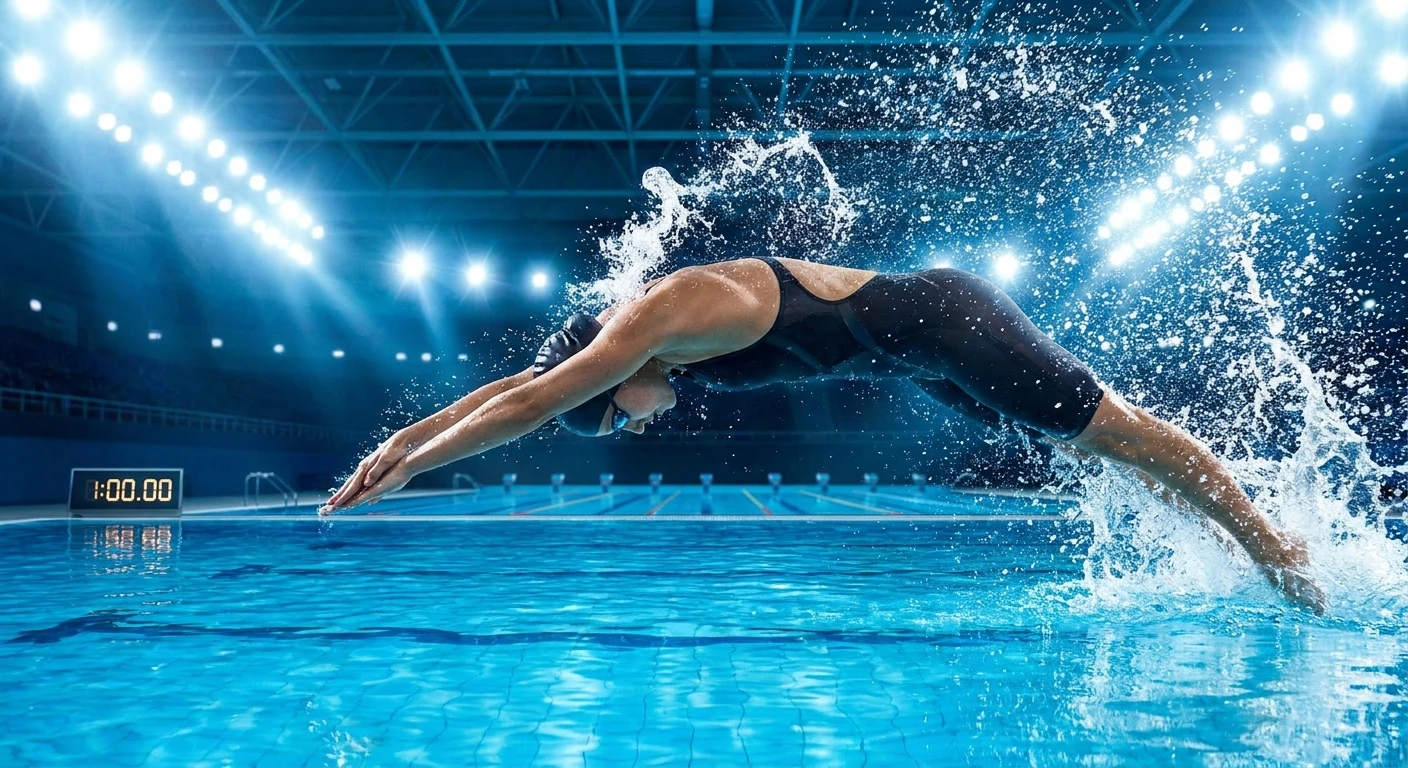
Today we perfectly combine pool speed with technical execution. Perform sets of 25-meter dashes directly from a diving block. Have someone record your starts on video so you can closely analyze your entry angle. Ensure your hands enter a single hole in the water followed by a tight, streamlined body.
Day 6: Technique, Drills, and Turns
Speed is completely useless if you lose your momentum on the wall. Dedicate this entire session to perfecting flip turns and underwater dolphin kicks. Practice accelerating into the wall and driving off with your feet planted firmly. Do specific catch-up drills to refine your arm stroke mechanics and timing.
Day 7: Complete Rest and Mental Reset
Elite athletes know very well that rest is a powerful weapon. Stay completely away from the pool today. Eat highly nutritious, protein-rich foods to repair damaged muscle fibers, hydrate aggressively throughout the day, and engage in mental visualization. Picture your perfect race from the block to the final touch.
Myths & Reality
The intense world of professional swimming is constantly surrounded by misconceptions. Let us clear up some of the most common myths right now.
Myth: Sprinters only train by swimming as fast as they can every single day of the week.
Reality: If athletes sprinted every day, their central nervous systems would completely burn out within a month. Elite sprint training actually involves meticulously balanced cycles of aerobic base work, heavy weightlifting, and highly specific, low-volume but high-intensity speed days.
Myth: Her professional career was completely over after the highly publicized 2019 suspension.
Reality: While it was an incredibly devastating setback, her highly successful appeal at the Court of Arbitration for Sport proved it was accidental contamination. She successfully returned to the sport, proving her unmatched resilience by qualifying for the highest levels of competition, including winning gold at the Olympics.
Myth: Relay swimmers do not need an individual race strategy because they just swim fast.
Reality: Relay legs are incredibly strategic and complex. Swimmers must manage the massive wash and waves from the previous swimmer, execute a flawless, perfectly timed takeover, and carefully manage their own physiological pacing to ensure they do not fatigue in the critical final 15 meters.
When did Shayna Jack start competitive swimming?
She began swimming at a very young age, quickly moving up the junior competitive ranks in Australia due to her natural explosive speed and exceptional feel for the water.
What is her primary swimming stroke?
She specializes almost exclusively in freestyle, specifically focusing her training and racing on the highly explosive 50-meter and 100-meter sprint events.
Did she compete in the Paris Olympics?
Yes, after a remarkably long journey of redemption and rigorous training, she successfully represented Australia at the 2024 Paris Olympic Games, contributing significantly to the nation’s immense success in the pool.
What was the outcome of her CAS appeal?
The Court of Arbitration for Sport formally concluded that she did not intentionally ingest the banned substance, significantly reducing her ban and allowing her to proudly resume her professional swimming career.
How tall is she?
She stands approximately 1.80 meters tall, which uniquely gives her an excellent biomechanical advantage, including a very long wingspan that is absolutely crucial for powerful freestyle pulling.
Which Australian swimming club does she represent?
Throughout her impressive senior career, she has been heavily associated with St Peters Western, which is universally recognized as one of Australia’s most prestigious and high-performing swimming hubs located in Brisbane.
What are her absolute fastest events?
Her absolute best and most dominant performances come in the 50m freestyle and 100m freestyle, both individually and as a highly critical anchor or middle leg in the 4x100m freestyle relays.
Conclusion
The remarkable journey of Shayna Jack is far more than just a historical timeline of gold medals and lightning-fast race times. It is a genuine masterclass in human resilience, biomechanical perfection, and the unyielding pursuit of the truth against all odds. Whether you are an aspiring amateur swimmer looking to completely refine your sprint technique, or just a passionate fan of incredible sports comeback stories, her ongoing legacy in the water offers endless inspiration. If you found this detailed breakdown of her career and training insights valuable, be sure to share this article with your fellow swimming enthusiasts and start applying these championship mindsets to your own goals today!