
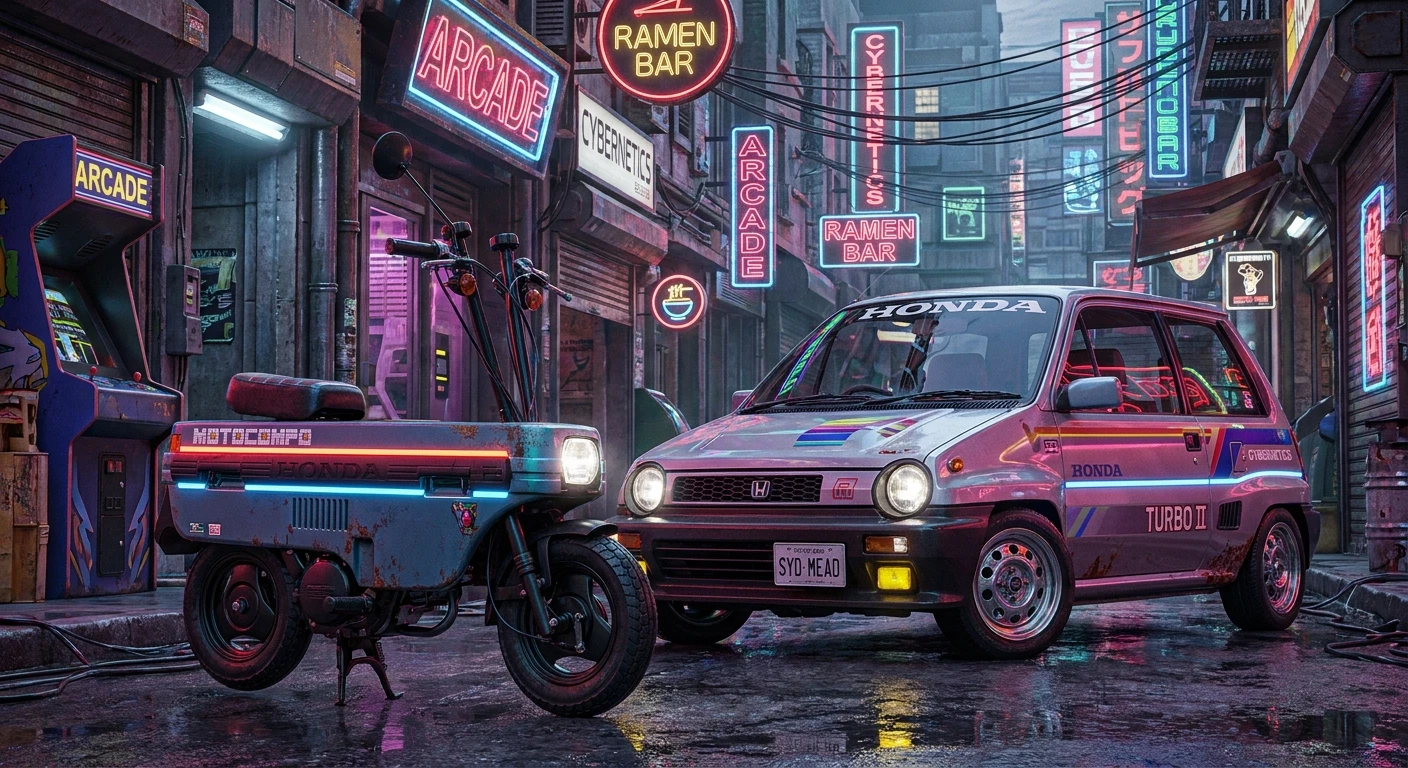
The Legacy of the Honda Motocompo
When you hear the phrase Honda Motocompo, you are immediately looking at one of the boldest and most fascinating engineering experiments of the entire 1980s era. During a period defined by massive economic expansion and rapid technological innovation in Japan, automotive engineers faced a severe structural problem: ultra-dense urban traffic and an absolute lack of convenient city parking. The visionary response to this logistical nightmare was a brilliantly packaged micro-scooter specifically engineered to function alongside a matching subcompact automobile. The core philosophy was ultimate micro-mobility, presenting a flawless transition between highway driving and final-destination urban navigation. Decades before modern electric scooters dominated major city sidewalks, this tiny gasoline-powered marvel proved that immense utility could emerge from an impossibly small, beautifully designed rectangular box. The sheer mechanical brilliance of a vehicle that folds perfectly flat to sit securely in a standard car trunk forces an entirely new perspective on personal transport. The Honda Motocompo remains a testament to an era when manufacturers prioritized extreme functionality alongside radical aesthetic experimentation, leaving behind a profound cultural legacy that continues to captivate vintage machinery enthusiasts across the globe.
Understanding the Genius of the Trunk Bike Concept
The fundamental operating principle behind this remarkable machine rests on absolute spatial efficiency and uncompromising modularity. Every single component of the scooter serves a highly specific dual purpose, strictly minimizing the overall physical footprint without completely sacrificing rider comfort or structural integrity. You get a fully functional, street-capable motorized vehicle that effectively vanishes into a neat, geometric package when not in active operation. The core value proposition here is heavily weighted toward extreme portability, unmatched visual appeal, and legitimate daily utility. Consider the mechanics of the classic daily commute during the height of the urban transit crunch. A driver successfully parks their primary commuter vehicle safely outside the dense, heavily congested central traffic zones, entirely avoiding astronomical parking garage fees and the endless frustration of gridlocked avenues. They simply open the rear hatch, extract the compact plastic pod, lift the handlebars into their locked riding position, unfold the padded seat, and effortlessly ride the final few miles directly to the office doorway. Another prime example of its enduring utility involves recreational adventuring. Dedicated enthusiasts frequently pack the lightweight machine into the cargo bay of a modern camper van or a spacious station wagon, driving out to a remote, scenic wilderness location and subsequently using the miniature two-wheeler to thoroughly explore local paved trails without breaking down their main automotive campsite.
Read also: Master the Savo Dokić System Today; Stax Clothing: The Ultimate Premium Activewear Guide; How to Wash Wool Blanket Safely at Home: A Complete Guide.
| Specification Category | Detailed Technical Metric | Direct Commuter Benefit |
|---|---|---|
| Engine Displacement | 49cc Two-Stroke Single Cylinder | Provides highly responsive low-end torque for quick acceleration in dense traffic without adding unnecessary weight to the chassis. |
| Dry Weight Measurement | 42 Kilograms (Approximately 92 lbs) | Maintains a profile light enough to be manually lifted by a single average adult safely into a compact hatchback cargo area. |
| Integrated Folding Mechanism | Collapsible Handlebars, Foot Pegs, and Seat | Transforms the operational vehicle into a completely flat rectangular box, ensuring delicate parts never snag or break during transport. |
Beyond its utilitarian brilliance, there are specific factors that elevated the machine to its current legendary status. Collectors and casual fans alike flock to the design for several highly distinct reasons that set it apart from any other miniature motorcycle ever produced.
- Unmatched Pop Culture Resonance: Its highly prominent, recurring feature in classic Japanese animation series permanently cemented its status as a futuristic, cyberpunk-adjacent cultural icon long after the actual production lines ceased operation.
- Absolute Mechanical Simplicity: The highly utilitarian air-cooled motor remains incredibly accessible and exceptionally easy to maintain, requiring minimal specialized tools or advanced mechanical knowledge for standard garage upkeep.
- Timeless Boxy Aesthetics: The rigid rectangular plastic side fairings and completely flat top instantly evoke an era of retro-futuristic industrial design that remains highly sought after by modern automotive collectors and museum curators alike.
The Origins of the Trunk Bike Concept
In the late 1970s, forward-thinking engineers realized that sheer automotive size was rapidly becoming a severe liability in increasingly congested metropolitan sectors. The original concept was birthed through a highly unusual collaboration between the four-wheeled automotive division and the two-wheeled motorcycle division. They conceptualized a complete transit ecosystem where a specifically designed subcompact car—the now-famous City—would feature a precisely molded rear cargo compartment dedicated entirely to housing a companion micro-scooter. This seamless integration aimed to provide a truly comprehensive transportation solution, aggressively targeting young urban professionals who required absolute flexibility in their daily transit routines.
Evolution During the Production Run (1981-1983)
Entering the highly competitive consumer market alongside its automotive sibling, the micro-scooter immediately turned heads with its vivid color options, primarily offered in Daisy Yellow, Shetland White, and Caribbean Red. Despite the incredibly innovative nature of the combined marketing strategy, the actual retail lifecycle proved surprisingly brief. The demanding necessity of physically lifting a forty-five-kilogram object into a vehicle trunk proved slightly too cumbersome for the general public’s daily routine, resulting in lower-than-anticipated sales figures. Consequently, production was permanently halted after merely a few years, inadvertently laying the crucial groundwork for immense future scarcity.
The Modern State of Vintage Collecting
Decades after the absolute final unit rolled off the Japanese assembly line, the perception of the tiny folding machine shifted dramatically. It organically transitioned from a quirky, somewhat impractical dealer accessory into an exceptionally highly prized collector’s artifact. Enthusiasts now scour international import auctions and specialized vintage classifieds, regularly driving bidding wars to astronomical heights. The surviving models are frequently treated to meticulous, museum-quality restorations, proudly displayed at prestigious car shows rather than being subjected to the grueling daily urban commutes they were originally engineered to tackle.
Folding Mechanism Geometry and Engineering
The core technological innovation lies entirely within the brilliant mathematical geometry of the steering column and main chassis frame. To achieve the perfect rectangular shape required for trunk storage, engineers developed a specialized release knob system that allows the entire handlebar assembly to drop vertically directly into the hollow body shell. Simultaneously, the heavily padded seat manually depresses flush against the top deck, while the spring-loaded foot pegs effortlessly fold directly upward into recessed cavities on the lower engine casing. This carefully orchestrated mechanical ballet guarantees that absolutely nothing protrudes beyond the smooth plastic side panels, creating a perfectly flush exterior dimension.
Powertrain and Two-Stroke Dynamics
Propulsion relies entirely upon a remarkably compact AB12E air-cooled motor engineered for maximum durability within a highly restricted thermal environment. Producing precisely 2.5 horsepower at 5,000 revolutions per minute, the motor aggressively prioritizes immediate low-end torque over high-speed performance, perfectly suiting its intended environment of stop-and-go city gridlock. The entire driveline is masterfully packaged beneath the rider, utilizing a specially tuned miniature expansion chamber to route exhaust gases safely away from the surrounding plastic fairings while keeping the overall decibel levels surprisingly low for a small-displacement machine.
- Spill-Proof Fuel System: Features a specialized manual shut-off valve mechanism and a hermetically sealed gas cap designed explicitly to prevent hazardous liquid leaks while the machine rests completely horizontally during transport.
- Automatic Centrifugal Clutch: Entirely eliminates the complicated need for a manual foot-operated gear selector or hand clutch, making the vehicle perfectly accessible and exceptionally safe for novice riders wearing heavy urban footwear.
- Integrated Oil Injection Pump: Removes the daily hassle of manually measuring and pre-mixing gasoline and lubrication fluids, seamlessly utilizing a dedicated internal reservoir system to precisely meter oil directly into the carburetor manifold.
- Compact Exhaust Routing Strategy: The main thermal expansion chamber is cleverly tucked completely within the lower steel cradle structure to protect the rider’s legs from severe burns while meticulously preserving the strict rectangular exterior footprint.
Step 1: Sourcing a Complete Rolling Chassis
Finding a prime, unmolested specimen requires tremendous patience and highly active monitoring of international automotive auction platforms. You must carefully filter through countless listings to locate a chassis that fundamentally retains its original structural integrity. Avoid severely rusted frames at all costs, as the specialized sheet metal components are notoriously difficult to replicate or repair safely without compromising the delicate folding geometry.
Step 2: Evaluating the Proprietary Plastics
The exterior shell constitutes a highly significant portion of the machine’s intrinsic collector value. Carefully inspect the large rectangular side panels for severe stress cracks, deep gouges, or sun-faded discoloration. Because the original ABS-style material can become remarkably brittle over several decades of temperature fluctuations, securing a model with completely intact, factory-original bodywork drastically reduces the immense financial burden of the overall restoration process.
Step 3: Inspecting the Two-Stroke Heart
Before ever attempting to aggressively fire up a dormant engine that has sat idle for decades, a rigorous mechanical inspection is absolutely critical. Thoroughly check the tiny cylinder bore for deep scoring, heavily evaluate the piston ring compression, and carefully clear out the delicate exhaust port. The underlying engine architecture is generally robust, but forcing an immediate cold start on dried-out crank seals will instantly result in catastrophic, highly expensive internal damage.
Step 4: Reviving the Foldable Steering Column
The locking collars, threaded knobs, and main steering hinges silently endure substantial physical stress over the years. You must thoroughly disassemble, chemically clean, and liberally lubricate the entire vertical drop mechanism to ensure the handlebars confidently lock into their rigid upright riding position. A loosely maintained steering column creates a highly dangerous, totally unstable riding dynamic that severely compromises safety during tight cornering maneuvers.
Step 5: Sourcing Rare Original Replacement Parts
Because the initial production numbers were relatively low and strictly confined to the Japanese market, actively locating New Old Stock (NOS) parts demands dedicated networking. Join highly specialized online forums, actively participate in niche vintage scooter groups, and build strong relationships with overseas parts brokers. Items like original specific decals, factory seat covers, and specialized original rubber grommets often require intense global searches to finally secure.
Step 6: Addressing the Fuel and Oil Delivery Systems
Old, untreated gasoline rapidly deteriorates over time into a thick, highly corrosive varnish that absolutely ruins tiny brass carburetor jets and delicate internal fuel petcocks. You must completely remove the internal metal tank, perform a harsh chemical rust-removal flush, and meticulously rebuild the microscopic carburetor assembly. Furthermore, precisely bleeding the mechanical oil injection pump guarantees the engine receives the exact lubrication required to prevent sudden catastrophic seizures.
Step 7: Performing the Final Safe Riding Calibration
Once painstakingly reassembled, conducting slow, methodical low-speed calibration tests on closed pavement ensures everything operates flawlessly. Carefully verify the aggressive engagement point of the automatic clutch, test the immediate bite of the front and rear drum brakes, and continuously monitor the tiny engine for any signs of abnormal thermal behavior. Only after confidently passing these rigorous shakedown tests is the machine finally ready for legitimate urban exploration.
Debunking Common Historical Misconceptions
Myth: The vehicle was an immediate and massive commercial success that completely dominated the global scooter market upon its initial release.
Reality: Sales figures actually fell significantly short of Honda’s highly optimistic initial projections, ultimately leading to a severely truncated, remarkably brief production cycle of just a few short years.
Myth: Transporting the machine horizontally on its side guarantees a car trunk completely ruined by violently leaking motor oil and corrosive gasoline.
Reality: When operators strictly follow the official factory shut-down procedures and firmly close the specialized manual ventilation knobs, the liquid delivery system becomes entirely sealed and perfectly safe for long-term horizontal transit.
Myth: The microscopic eight-inch tires make the chassis completely unstable and inherently dangerous to navigate on any standard paved surface.
Reality: The exceptionally low center of gravity and remarkably balanced bottom-heavy weight distribution actually provide highly surprising straight-line stability for short, controlled trips across smooth urban asphalt.
What is the top speed of a Honda Motocompo?
Depending heavily on the total rider payload, tire pressure, and prevailing road incline, operators can typically reach maximum speeds of approximately 30 kilometers per hour, which is perfectly adequate for highly congested central city zones.
How much does the vehicle physically weigh?
The standard factory dry weight sits right at an incredibly light 42 kilograms, while a fully operational machine completely loaded with necessary gasoline and injection oil weighs approximately 45 kilograms total.
Was it officially sold in broad international markets?
No, the machine was exclusively marketed and officially sold solely within the Japanese Domestic Market (JDM), though numerous enthusiastic units were subsequently imported globally by dedicated private collectors over the following decades.
Can it easily fit in the trunk of entirely modern cars?
Absolutely. The uniquely clever rectangular folded dimensions allow the entire chassis to slide completely effortlessly into the rear cargo area of nearly any modern compact hatchback, mid-sized SUV, or reasonably sized family sedan trunk.
Is the scooter fully street legal for public roads?
In the vast majority of international jurisdictions, it strictly qualifies as a standard 49cc moped or motorized scooter, making it completely legal for municipal street usage provided the operator secures proper vehicle registration and mandated insurance.
Did the manufacturer ever release an updated electric version?
While the original beloved chassis remains strictly gasoline-powered, the core ultra-compact philosophy recently returned triumphantly with a completely modern, entirely electric spiritual successor specifically designed for contemporary zero-emission micro-mobility requirements.
What specific type of fuel does the internal engine require?
The highly durable motor utilizes standard high-quality unleaded gasoline tightly coupled with specialized two-stroke motorcycle injection oil, which is conveniently stored in a separate, easily accessible internal plastic reservoir tank.
Conclusion: The Enduring Brilliance of the Ultimate Micro-Machine
The Honda Motocompo continuously proves that truly exceptional, wildly imaginative design logic never actually ages. By flawlessly merging compact automotive integration with incredibly robust two-wheeled mechanical practicality, it permanently altered the broad landscape of what personal urban transportation concepts could realistically achieve. Whether you are actively hunting for an exhaustive restoration candidate at an obscure overseas auction house or simply appreciating its sheer mechanical genius from afar, its immense cultural and engineering legacy remains absolutely undeniable. Start thoroughly scanning those highly specialized vintage auction boards today, carefully prepare your ultimate restoration strategy, and you might just successfully secure your very own operational piece of brilliant motorized history to completely revolutionize your local daily commute.