
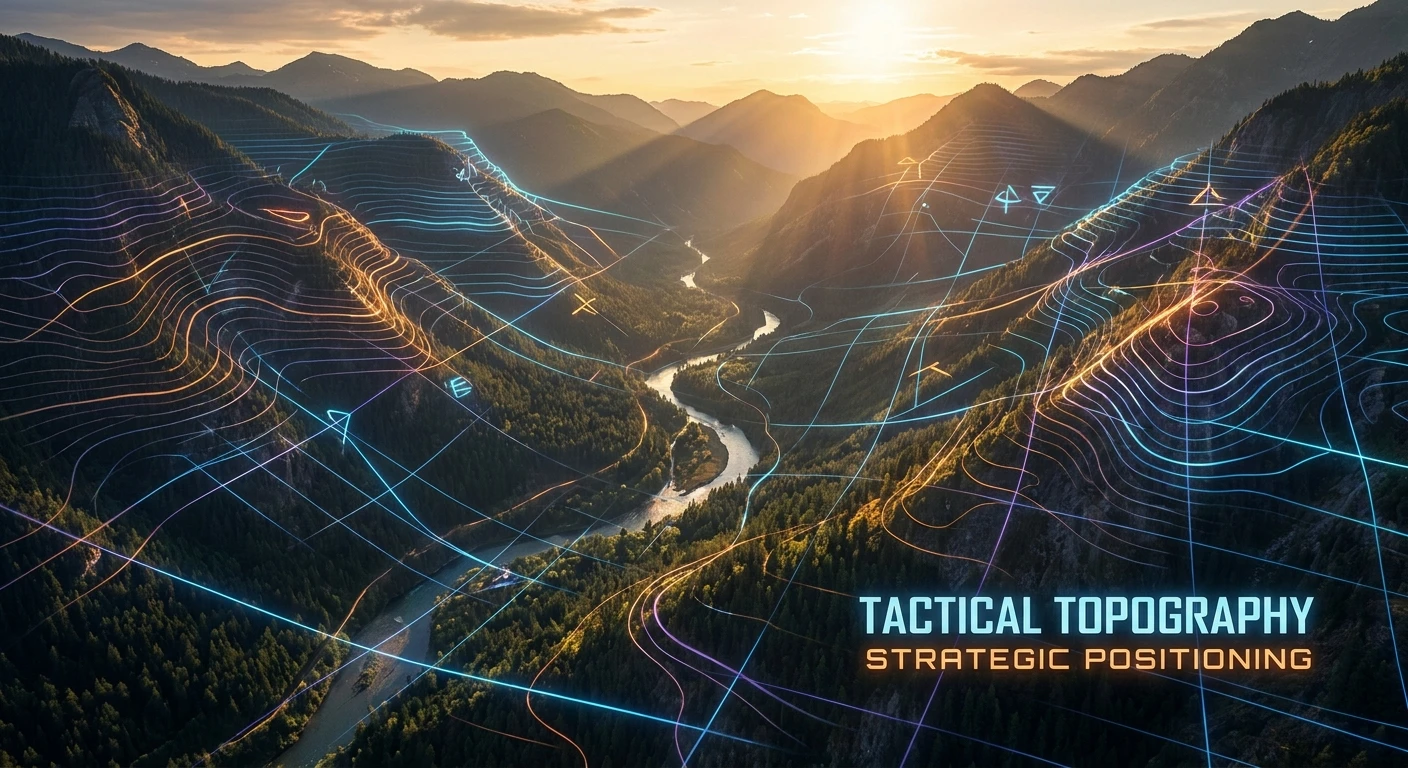
The Ultimate Valley Combat Guide: Mastering Topographical Geometry
Listen, grabbing the high ground is not just some tired cinematic trope; it is the absolute foundation of any serious valley combat guide. When you find yourself navigating steep ridges, unpredictable weather patterns, and the notoriously deadly choke points of a deep gorge, having a reliable tactical framework makes all the difference in the world. Whether you are coordinating a squad in an advanced military simulation, dominating a competitive tactical shooter, or studying historical terrain tactics, understanding the topographical geometry of valleys is completely non-negotiable. Valleys naturally funnel movement, severely restrict line of sight, and create distinct, mathematically proven advantages for whoever controls the elevation. A solid thesis for mastering this unforgiving environment relies entirely on three foundational pillars: terrain reading, movement timing, and elevation control. Operating in a geographical depression means you are inherently vulnerable to flanking maneuvers from the ridges looming above you. We need to completely break down how wind shear, shadow manipulation, and funneling affect your positioning. The comprehensive strategies detailed here focus entirely on minimizing your exposure while maximizing your observational supremacy over the objective. By the time you finish processing this breakdown, you will understand exactly how to turn a massive geographical disadvantage into a highly lethal tactical trap, forcing opponents to play your game on your terms. Terrain always dictates strategy, and mastering a valley environment requires intense patience, precise geometry, and an absolute refusal to walk blindly into a natural bottleneck.
Understanding the Core Mechanics of Terrain Disadvantage
Understanding the exact geometry of a valley offers massive tactical benefits while mitigating severe environmental harms that usually eliminate unprepared squads. The primary value proposition here is pure survivability through advanced spatial awareness. For example, explicitly staying off the center path of the valley floor prevents you from being skylined against the horizon, instantly increasing your stealth. Another crucial example is the manipulation of shadow lines. Deep valleys create heavy, predictable shadows depending on the sun’s trajectory, allowing you to move entirely undetected if you strictly time your rotations to match the shifting darkness. Let us look directly at the basic terrain variables in a standard valley simulation environment.
Read also: Master the Savo Dokić System Today; kadir ors: A Complete Guide to Success; How to Survive a kimberley cyclone Safely.
| Terrain Feature | Tactical Advantage | Inherent Tactical Risk |
|---|---|---|
| Valley Floor | Rapid movement speed and easy navigation | Maximum 360-degree exposure, zero elevation advantage |
| Military Crest | Excellent visibility with a completely concealed silhouette | Susceptible to rear flanking, limited downhill escape routes |
| Narrow Choke Points | Perfect for staging ambushes and setting traps | Extreme vulnerability if caught traversing without overwatch |
Executing a successful movement through a hostile valley requires strict adherence to a specific set of operational steps. Bypassing any of these guarantees you will be caught out of position and sent back to the lobby.
- Establish Ridge Control First: Before even thinking about moving into the lower elevations, you must completely secure at least one side of the upper ridge to provide continuous overwatch and relay enemy movements to the team below.
- Identify and Utilize Dead Space: Carefully map out the specific areas where line of sight is broken by rocks, trees, or natural curves in the terrain, and strictly use these zones as your primary transit routes.
- Implement Bounding Overwatch: Never, under any circumstances, move your entire team at once. One element must always stay stationary behind hard cover to protect the moving element, alternating this process until the objective is reached.
- Secure the Bottlenecks: Pre-aim and assert control over the narrowest parts of the valley where an opponent is mathematically forced to pass through to progress.
This calculated approach ensures you are never caught flat-footed in the wide open. You dictate the engagement distance, and more importantly, you entirely control the timing of the encounter.
Origins of Topographical Tactics
The foundational concepts of valley engagement trace back directly to classical military doctrine, where ancient commanders quickly realized that gravity and line of sight ultimately dictated the victor of any skirmish. Historical engagements almost always hinged on who controlled the pass and who successfully held the high ground before the first move was even made. Ancient tacticians meticulously noted that marching an element through a confined valley floor without securing the adjacent peaks resulted in disastrous, one-sided ambushes. This brutal era established the golden rule of terrain management: elevation equals information, and information equals total control. The physical exhaustion required to fight uphill also played a massive role, physically draining an advancing force long before the actual engagement even began, making the high ground a force multiplier.
Evolution in Tactical Simulations
As tactical analysis aggressively moved from physical paper maps to complex digital simulations and modern competitive war-gaming, the core mechanics of valley navigation evolved significantly. Early software simulations treated valleys simply as basic slow movement zones or linear paths with no real depth. However, as game algorithms grew exponentially more sophisticated, developers introduced dynamic line of sight, complex wind resistance for ballistics, and dense foliage rendering that accurately mimicked real-world blind spots. Digital tacticians had to adapt immediately. The highly simplistic idea of just running up the hill was quickly replaced by highly nuanced strategies involving the military crest, defilade positioning, and calculated shadow utilization. Modern simulations began heavily punishing players who actively ignored the micro-terrain, which are the small dips and folds in the digital earth that provide just enough cover to survive a crossfire.
Modern State of Terrain Meta
Today, the modern approach to navigating these complex environments relies heavily on intense data analytics, map knowledge, and predictive behavioral modeling. We no longer just guess where an opponent might be hiding; we calculate the most mathematically efficient path of least resistance and set our traps accordingly based on timing metrics. The current meta heavily favors asymmetrical engagement principles. This means aggressively avoiding a fair fight at all costs. Modern tacticians use aerial drones or advanced optics to continuously scout the valley floor from a secure, hidden position on the ridge. The focus has entirely shifted from direct, brute-force confrontation to psychological area control, forcing the opposition to burn valuable resources and clock time trying to clear a valley that may not even be occupied by your forces.
Topographical Geometry Explained
To truly master this harsh environment, you have to deeply understand the hard science of topographical geometry. When we talk about a valley, we are primarily dealing with a severe V-shaped or U-shaped depression in the earth’s surface. The exact steepness of the gradient directly impacts your field of view. A scientific concept known as dead space is absolutely crucial here. Dead space refers strictly to the specific areas that cannot be seen from a specific vantage point due to the curvature of the earth or intervening rock formations. If you are positioned at the absolute peak of a mountain, the steep slope immediately below your boots is often pure dead space. You literally cannot see an opponent climbing right beneath your feet. This is exactly why the military crest, defined as the highest contour line on a hill or ridge that allows you to see the valley floor without being silhouetted against the bright sky, is scientifically superior to the actual topographical crest.
Atmospheric and Ballistic Variables
The pure physics of operating in a deep depression also drastically alter environmental variables, specifically acoustics and long-range ballistics. Valleys act as massive natural echo chambers, heavily distorting sound waves and making it incredibly difficult for the human ear to pinpoint the exact origin of a noise. Furthermore, atmospheric barometric pressure and high-altitude wind currents behave very differently when aggressively funneled through a narrow rocky gorge.
- Wind Shear Tunneling: Narrow valleys physically compress air, vastly increasing wind velocity and drastically altering the predictable trajectory of long-range projectiles.
- Thermal Inversion Layers: Cold, heavy air settles rapidly in the valley floor at night, creating dense, blinding fog that severely limits visibility, while the upper ridges remain crystal clear.
- Acoustic Reflection: Violent sound waves bounce aggressively off the steep rock walls, creating a scientific phenomenon known as multipath propagation, which highly confuses directional hearing and spatial audio.
- Elevation Angle Gravity: Firing a projectile at an extreme upward or downward angle means gravity has significantly less perpendicular effect on the trajectory, causing the projectile to strike noticeably higher than the standard flat-range zero.
Day 1: Mastering the Topographical Map
Your very first step is purely analytical and requires absolute focus. Spend this initial time intensely studying contour lines on topographical maps. Identify the sharp V-shapes that indicate steep valleys and the wide U-shapes indicating glacial troughs. Practice finding the exact military crest on a 2D map without looking at a 3D rendered model. This builds your foundational spatial awareness.
Day 2: Scouting and Route Planning
Do not actually enter the live environment yet. Meticulously outline three distinct, separate routes through your chosen valley map: a primary route moving along the upper ridge, a secondary stealth route using micro-terrain for cover, and an emergency egress route for immediate retreat. Never, ever rely on a single linear path.
Day 3: Shadow and Sun Angle Synchronization
Calculate the sun’s exact trajectory across your chosen terrain. Practice moving exclusively within the deep shadows cast by the surrounding ridges. This drastically reduces your visual signature and completely masks your movement from optical sensors or human observers positioned on the opposite ridge.
Day 4: Dead Space Identification
Walk the terrain specifically to locate and catalog the blind spots. Stand at the highest structural points and map out exactly what you cannot see below you. These mapped dead spaces are your safest possible zones for staging, resting, or setting up a counter-ambush.
Day 5: Implementing Bounding Overwatch
Practice the rigorous mechanics of moving with a partner or a full team. One element remains entirely stationary behind solid hard cover, maintaining strict optics on the ridge, while the second element aggressively sprints to the next piece of cover. Repeat this leap-frog method until you clear the danger zone.
Day 6: Acoustic Discipline and Masking
Learn exactly how your specific valley echoes. Practice intentionally moving during environmental noise events, like high wind gusts or loud aircraft flying overhead, to perfectly mask your footsteps. Understand that stepping on a loose rock in a tight gorge sounds mathematically twice as loud as it does on an open plain.
Day 7: Executing the Choke Point Trap
Put all the mechanics together. Identify the absolute narrowest funnel in the entire valley. Position yourself perfectly on the military crest overlooking this specific funnel. Use your deep knowledge of dead space to remain completely hidden, and practice your engagement timing precisely as an opponent is forced through the bottleneck.
Myths Versus Tactical Reality
There are countless dangerous misunderstandings about how to successfully operate in these complex environments. Let us clear up the bad data right now.
Myth: The highest absolute peak is always the best tactical position to hold.
Reality: The absolute peak perfectly silhouettes you against the bright sky, making you an incredibly easy target for everyone below. The military crest, slightly lower down the slope, provides the exact same visibility without the deadly silhouette.
Myth: The flat valley floor is the fastest way to travel and therefore the most efficient.
Reality: While physically faster to run across, the valley floor is a known fatal funnel. You are fully exposed from 360 degrees of higher elevation. It is mathematically the most dangerous route possible.
Myth: Sound always travels directly to you in a deep canyon.
Reality: Sound waves bounce aggressively off the steep stone walls, creating a highly deceptive echo. What sounds exactly like movement on your left could easily be an acoustic reflection originating from your right.
Myth: Wearing perfect camouflage makes you completely invisible in a valley.
Reality: The human eye catches movement far faster than it recognizes color. Even perfect digital camouflage completely fails if you move too quickly across an open slope without using the micro-terrain.
What exactly is the military crest?
It is the highest functional point on a hill or ridge where you can still clearly see the absolute bottom of the valley, preventing you from being silhouetted against the sky and spotted from below.
How do I completely avoid being ambushed in a gorge?
Never travel straight down the exact center of the valley floor. Always secure the highest ridges first and strictly use bounding overwatch to cover your squad’s movement from cover to cover.
Why do projectiles hit high when shooting downhill?
When shooting at steep downward angles, gravity acts significantly less on the projectile’s trajectory perpendicular to the line of sight, meaning much less drop occurs compared to shooting on flat ground.
What is a fatal funnel?
A fatal funnel is a highly narrow choke point in the terrain, like a tight canyon pass or a bridge, where your lateral movement is completely restricted and lateral escape is functionally impossible.
How does thermal inversion affect my visibility?
Cold, dense air sinks rapidly to the valley floor, trapping ambient moisture and creating a dense fog that completely blocks visibility at low elevations while keeping the high peaks clear.
Can I safely use the dried riverbed as a path?
Riverbeds are generally the absolute lowest and most highly exposed points in any valley. They are tactical nightmares and should be crossed as quickly as possible, never used as a main highway.
What exactly is dead space?
Dead space is any specific area within your theoretical direct line of sight that is heavily obscured by the natural curvature of the earth, dips in the terrain, or dense foliage.
How important is strict acoustic discipline?
It is incredibly important. The steep, rocky walls of a valley literally act as a giant megaphone, artificially amplifying and reflecting every snapped twig, dropped magazine, or loose rock.
What is bounding overwatch?
It is a core movement technique where one team member actively provides cover fire or observation while the other moves, ensuring someone is always ready to instantly react to contact.
Should I move at night or during the day?
Moving at night heavily minimizes visual detection but greatly increases the massive risk of acoustic detection due to much lower ambient environmental noise. It depends entirely on the quality of your optical equipment.
Mastering this punishing terrain is a continuous, never-ending process of calculating precise geometry, understanding atmospheric physics, and maintaining incredibly strict movement discipline. You simply cannot just wing it when gravity, acoustics, and line of sight are all actively working against you. Take these foundational principles, apply them directly to your next simulation or field exercise, and watch how quickly the environment becomes your greatest strategic ally rather than your worst enemy. Ready to absolutely dominate the high ground? Bookmark this complete valley combat guide, share the intel with your squad, and start aggressively practicing your military crest positioning today!