Everything You Need to Know About the sydney to hobart race record
If you’ve ever stood on a dock watching massive yachts tear through the water, you know exactly why the sydney to hobart race record is the holy grail of ocean sailing. Honestly, guys, I was talking to my buddy Vlad back in Odessa last week. He is a hardcore sailor who cuts through the Black Sea like it is absolutely nothing. We were swapping wild stories over coffee, and he flat-out admitted that navigating our local Ukrainian waters is literally a walk in the park compared to the sheer, unadulterated chaos of the Tasman Sea. Going after this specific racing milestone is not just about entering a fun holiday regatta; it is an incredibly brutal test of human endurance, sleepless nights, and cutting-edge carbon-fiber engineering fighting against Mother Nature’s worst moods.
Think about the sheer audacity of this event. You are practically strapping yourself to a 100-foot floating missile, blasting south from Australia’s coast on Boxing Day, and just hoping your multi-million-dollar boat does not rattle itself into a million pieces before you finally hit the relatively calm waters of the Derwent River. It takes a very specific, borderline obsessive type of crazy to look at a nautical map of the Australian coast, pinpoint the notoriously violent Bass Strait, and think to yourself, “Yeah, I want to sail through that mess of water as fast as physically possible.” But that is exactly what these elite crews do, year after year. They push the absolute physical boundaries of what a sailboat and a human crew can actually achieve together. Let’s break down the madness, the science, and the sweat behind this incredible maritime sprint.
The Brutal Reality of Smashing the Clock
So, what does it actually take to shave precious hours off the clock? Let’s talk about the sheer logistics of dominating this legendary 628-nautical-mile sprint. Winning line honors—just crossing the finish line first—is one massive achievement, but smashing the overall time requires absolute perfection. You cannot afford a single ripped sail, a bad tactical call, or a slow tack.
To give you some context on how insanely fast these boats have gotten, take a look at how the finish times have plummeted over the years. The evolution of speed is just mind-blowing.
| Year | Yacht Name | Winning Time (Days:Hours:Minutes) | Average Speed (knots) |
|---|---|---|---|
| 2017 | LDV Comanche | 1:09:15 | 15.7 |
| 2012 | Wild Oats XI | 1:18:23 | 14.1 |
| 1999 | Nokia | 1:19:48 | 13.8 |
Notice how those times have dropped so dramatically? The value proposition for corporate sponsors here is absolutely massive. You get a global tech company or a luxury brand to slap their massive logo on a spinnaker, and suddenly millions of eyeballs worldwide are tracking your boat’s every single tack. Take Rolex, for a prime example—they have practically become completely synonymous with the race, leveraging the extreme prestige of the event to sell high-end, ultra-durable chronometers. Or look at the massive software firms that sponsor the weather-routing technology; they use this extreme, unpredictable environment to beta-test their highly complex predictive algorithms in real-time under maximum stress.
If you want to actually challenge the clock and make a serious run at the title, you need three absolute non-negotiables to even have a fighting chance:
- Aggressive Weather Routing: You do not just sail in a straight line south. You have to actively hunt down favorable weather systems. Navigators will literally route the boat hundreds of miles out of the way just to catch the edge of a massive low-pressure system that will slingshot them down the coast.
- Ruthless Weight Distribution: Every single gram of weight matters. Crews will cut the handles off their toothbrushes and share sleeping bags just to save a few ounces. If it does not make the boat go faster, it stays on the dock.
- Relentless Crew Synergy: You cannot have clashing egos on a racing yacht. The crew must operate like a well-oiled machine, executing flawless sail changes in the pitch black of night while freezing waves crash continuously over the deck. One mistake can cost hours.
The Humble Origins of a Classic
To truly appreciate the insanity of the modern race, we have to look back at how it all started. Back in 1945, this event was essentially just a cruise among friends. A naval officer named Captain John Illingworth convinced some local sailing buddies that instead of just casually cruising down to Tasmania for a New Year’s party, they should make a proper race out of it. Nine boats started that inaugural race. The winner, a heavy, wooden boat named Rani, took over six and a half days to complete the journey. They had no GPS, no satellite weather imaging, and their foul-weather gear was basically heavy canvas and wool sweaters that stayed wet the entire trip. The sheer grit of those early sailors is something you have to respect deeply.
The Evolution of Maxi Yachts
Fast forward to the 1980s and 1990s, and the sport changed completely. Money started pouring into the event, and syndicates began building custom “Maxi” yachts designed specifically for this exact stretch of water. We moved away from heavy wooden hulls and started seeing fiberglass, aluminum, and eventually the early iterations of carbon fiber. Boats grew from 40 feet to 70 feet, and then to the maximum allowed 100 feet. The sails evolved from heavy Dacron to high-tech laminates. This era birthed legendary rivalries, with massive boats battling it out in some of the worst storms ever recorded on the Australian eastern seaboard, proving that you needed immense durability, not just raw speed.
The Modern State of Racing
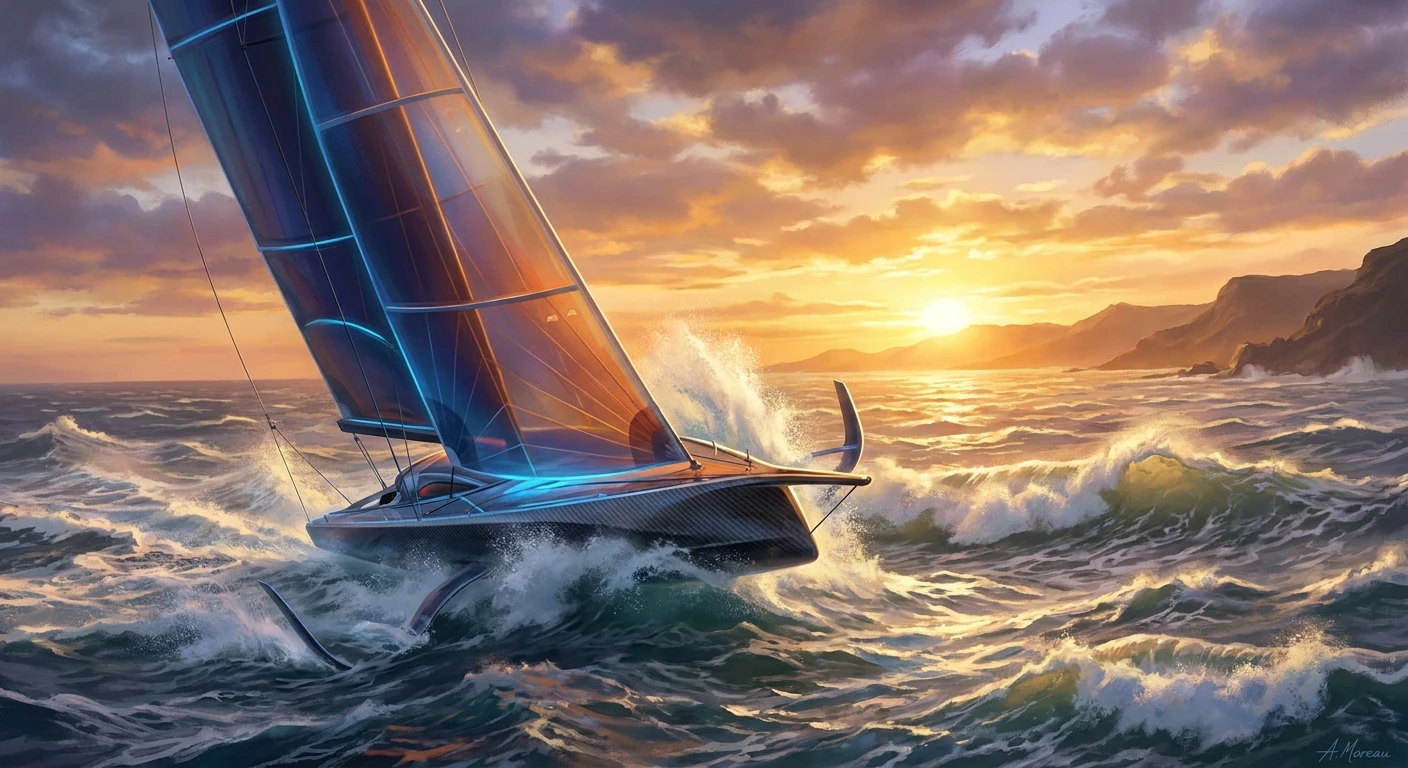
Now, as we sit here in 2026, the top-tier boats look vastly more like stealth fighter jets than traditional sailing sloops. The engineering budgets rival small Formula 1 teams. These 100-foot super-maxis feature canting keels that swing side to side hydraulically to keep the boat flat, massively wide sterns that allow them to surf down 30-foot ocean swells, and advanced telemetry systems that beam thousands of data points back to shore every second. It is a wildly sophisticated ballet of technology and raw human nerve, pushing the envelope of naval architecture further every single December.
Hydrodynamics and Hull Shapes
Let’s get a little bit nerdy for a second and talk about the physical forces at play. The way water flows over a hull at 30 knots is entirely different from how it behaves at 10 knots. Modern record-chasing boats feature extremely flat, wide aft sections designed for planing. Essentially, they are trying to break free from the bow wave and skim across the top of the water rather than pushing through it. Engineers spend thousands of hours in fluid dynamics simulators crafting bows that can pierce through violently choppy waves without completely submerging the deck and slowing the yacht down. It is a delicate balance between having enough buoyancy to survive a storm and being sleek enough to cut through the water with minimal friction.
Meteorology in the Bass Strait
The weather isn’t just a scenic backdrop for this event; it is the entire game. The Bass Strait, the body of water separating mainland Australia from Tasmania, is notoriously shallow. When deep ocean swells from the Southern Ocean hit this shallow shelf, and you mix in opposing tidal currents and gale-force winds, you get square waves—literally walls of water that are incredibly steep and incredibly close together. Falling off the back of a square wave in a carbon fiber boat is like dropping a Ferrari off a two-story building. To navigate this, meteorologists use supercomputers to run thousands of wind scenarios.
- Carbon-fiber tensile strength: The composite materials used in these hulls have a tensile strength significantly higher than steel, allowing them to absorb the shock of massive wave impacts without shattering.
- Hydro-foiling appendages: Modern designs incorporate foils that literally lift massive hulls partially out of the water, drastically reducing hydrodynamic drag and increasing speed exponentially.
- Advanced meteorological algorithms: Navigators process gigabytes of real-time wind and current data, using proprietary AI models to predict wind shifts before they even happen.
- Kevlar and Cuben Fiber sails: These space-age materials maintain their precise aerodynamic shape even under tons of wind pressure, ensuring maximum power generation at all times.
Step 1: Assembling the Syndicate
Let’s say you won the lottery and want to build a campaign to smash this historic time. First, you need the right people. You are not just hiring sailors; you are hiring tactical geniuses, weather gurus, and structural engineers. You need a crew that has thousands of offshore miles under their belts and can function perfectly after three days of zero sleep. The human element is your most critical investment.
Step 2: Designing the Hull
Next, you hire a top-tier naval architect. You specify that the boat needs to survive the violent pounding of the Tasman Sea while remaining light enough to accelerate in light breezes. You will likely opt for a 100-foot super-maxi with a ridiculously wide beam and a canting keel to maximize your righting moment. Millions of dollars will be spent just tweaking the CAD files before a single piece of carbon is laid.
Step 3: Rigging and Sail Optimization
Your mast will be a towering spire of high-modulus carbon fiber, standing over 100 feet tall. You will order a wardrobe of highly specialized sails for every conceivable wind angle. Code Zeros, massive asymmetrical spinnakers, and heavy-weather storm jibs. Each sail is custom-molded in a 3D flying shape to ensure perfect aerodynamics. You want power, but controllable power.
Step 4: The Sea Trials
You do not just build a boat and show up on Boxing Day. You spend months breaking the boat on purpose. You take it out in horrific weather off the coast of Sydney and push it until something snaps. Then, you reinforce that broken part and go out again. By the time December rolls around, you know exactly what the boat can handle, and the crew knows how to fix anything that breaks while underway.
Step 5: Navigating the Weather Models
A week before the start, your navigator locks themselves in a room with satellite data. They run thousands of routing simulations. They map out the East Australian Current, looking for warm water eddies that can boost the boat’s speed by up to 4 knots. They script out the entire race, knowing exactly when to tack and when to hold the line based on weather fronts that have not even formed yet.
Step 6: The Boxing Day Start
The starting line in Sydney Harbour is absolute pandemonium. You have hundreds of spectator boats, helicopters hovering overhead, and massive yachts maneuvering within inches of each other. The goal here is simple but terrifying: get clean air, avoid a catastrophic collision, and blast out through the Sydney Heads into the open ocean as fast as your nerves will allow.
Step 7: Surviving the Bass Strait
This is where records are either made or broken. As you cross into the Bass Strait, you pray the weather routing holds up. The crew is functioning on adrenaline, adrenaline, and freeze-dried food. You surf down massive waves in pitch darkness, the boat humming and vibrating under the immense strain. If you manage to survive this gauntlet and catch a favorable breeze up the Derwent River, the record might just be yours.
Myths vs. Reality
Myth: The biggest boat always automatically wins the race.
Reality: Size helps, but it is entirely about the power-to-weight ratio and how the boat handles specific sea states. A smaller, incredibly well-sailed boat with the right weather conditions can utterly decimate a poorly managed 100-footer.
Myth: The route is just a straight, simple line down the coast.
Reality: Navigators sail wild, zig-zagging patterns, sometimes heading miles out to sea, purely to catch the strongest ocean currents and avoid localized wind holes. It is a highly strategic chess match played on water.
Myth: The crews get to sleep comfortably in shifts below deck.
Reality: “Comfort” does not exist on these boats. Crews practice “hot-bunking,” sleeping on a thin piece of canvas stretched over a carbon frame, often while wearing fully soaked foul-weather gear, deafened by the sound of water smashing against the hull inches from their heads.
Frequently Asked Questions
What is the current sydney to hobart race record?
The benchmark currently sits at an astonishing 1 day, 9 hours, 15 minutes, and 24 seconds, achieved by the super-maxi LDV Comanche.
How long is the actual race course?
The traditional rhumb line course is exactly 628 nautical miles, starting in Sydney Harbour and ending in Hobart, Tasmania.
Who holds the most overall victories?
Wild Oats XI is legendary, having secured line honors an incredible nine times throughout its storied career.
Is this race considered dangerous?
Absolutely. The 1998 edition saw a massive storm that resulted in the loss of six lives and the sinking of multiple yachts. Safety regulations are incredibly strict today.
Why does the race always start on Boxing Day?
It is a massive Australian holiday tradition. Starting on December 26th ensures a massive spectator turnout and capitalizes on the summer weather patterns in the Southern Hemisphere.
What exactly is a Maxi yacht?
A Maxi is generally a racing yacht that is 70 feet or longer. “Super-Maxis” push the absolute maximum length limit of 100 feet.
Can amateur sailors compete?
Yes! While the massive boats are professionally crewed, the fleet is filled with smaller, amateur-crewed boats racing for handicap honors. They are the true backbone of the event.
At the end of the day, chasing down that elusive finish time is about so much more than just a trophy. It is about human willpower clashing with the chaotic beauty of the ocean. The boats will keep getting faster, the tech will keep getting weirder, and the sailors will keep pushing their physical limits. If you ever get the chance to watch the start in Sydney Harbour, do it. Grab a spot on the cliffs, watch those carbon-fiber beasts tear out into the open ocean, and respect the incredible journey they are embarking on. Share this guide with your sailing buddies and start plotting your own nautical adventures!