
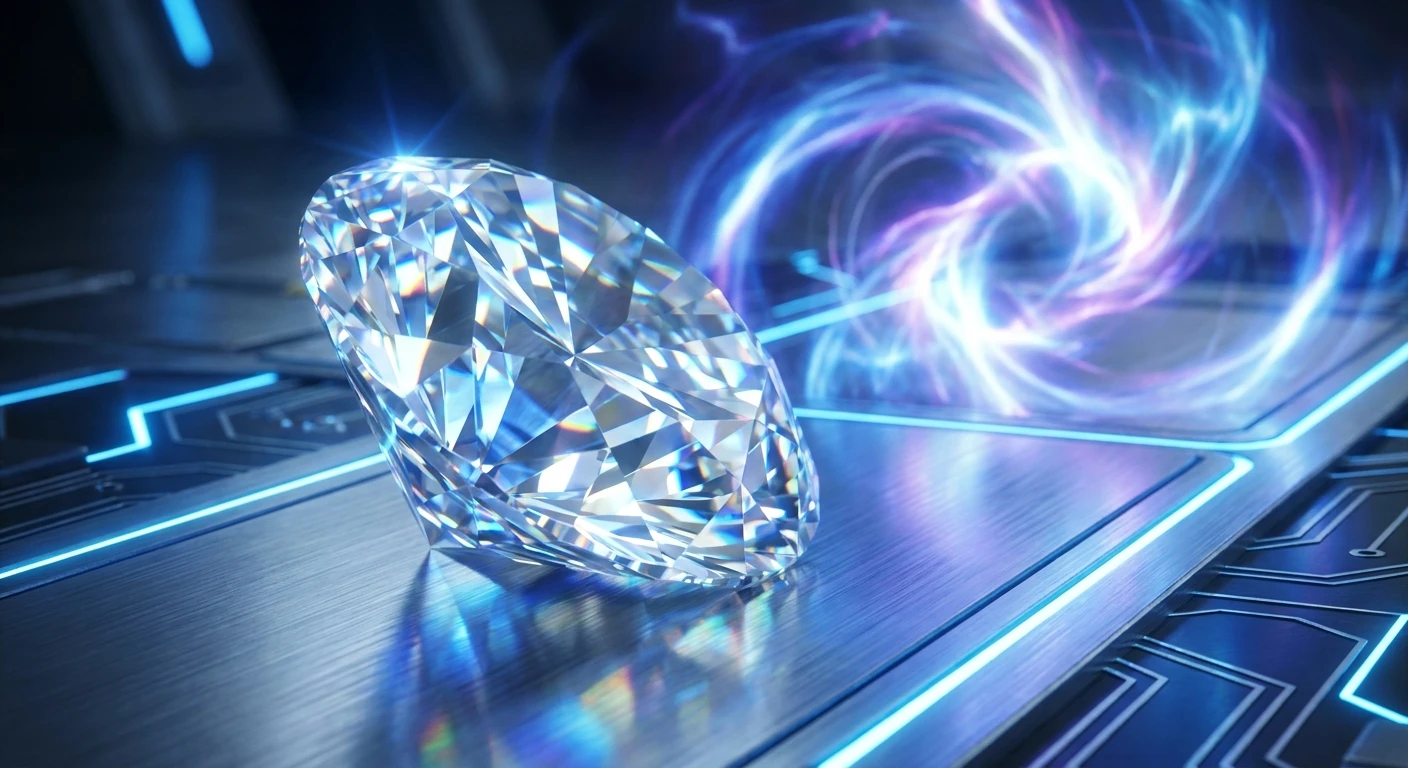
The Ultimate Question: Are lab grown diamonds real diamonds?
If you are standing at a jewelry counter right now, you are probably asking yourself: are lab grown diamonds real diamonds? You are definitely not alone. Just last week, my buddy from Kyiv was frantically texting me from a high-end boutique on Khreshchatyk. He was staring at two practically identical stones. One cost a fortune, and the other was half the price. The jeweler swore the cheaper one was just as real, but my friend was totally skeptical. He wanted to give his fiancée the best, but he also didn’t want to empty his bank account for a tiny rock.
So, I gave him the straight facts. Yes, they are 100% genuine. They share the exact same chemical makeup, optical properties, and physical hardness as stones pulled from the dirt. The only difference is where they come from. One took millions of years under the earth’s crust, and the other took a few weeks inside a highly advanced scientific chamber. Now that we are navigating through 2026, the technology has gotten so good that even master gemologists cannot tell them apart with their bare eyes. The stigma is completely gone. If you want serious sparkle without the hefty markup, this is the path you want to take. Let me walk you through exactly how this works, why it matters, and how you can score a massive, brilliant stone without the guilt.
The Core Benefits and True Value Proposition
When you start shopping, the first thing you notice is the price tag. But the advantages go way beyond just saving cash. The core value proposition of a lab-created stone is simple: you get maximum visual impact, identical durability, and zero ethical baggage. For example, instead of settling for a one-carat mined stone with a few visible inclusions, your exact same budget easily buys you a flawless two-carat lab stone. Another major example is ethical sourcing. You never have to worry about questionable mining practices or destroyed ecosystems. You know exactly where your stone originated—a clean, safe laboratory.
To give you a clearer picture, check out how they stack up against the alternatives:
| Feature | Lab Grown Diamond | Mined Diamond | Cubic Zirconia (Fake) |
|---|---|---|---|
| Chemical Makeup | Pure Carbon | Pure Carbon | Zirconium Dioxide |
| Hardness (Mohs Scale) | 10 (Maximum) | 10 (Maximum) | 8 – 8.5 |
| Average Cost | Very Affordable | Extremely High | Dirt Cheap |
| Visual Brilliance | Identical to Earth | Identical to Lab | Fades and Clouds |
If you are still wondering how to prove your stone is the real deal, there are three guaranteed ways to verify it. Follow these specific steps to give yourself total peace of mind:
- Ask for the official certification: Any reputable seller will provide a grading report from an established institute like IGI or GIA, proving its exact chemical structure.
- Check the laser inscription: Almost all created stones have a microscopic serial number laser-etched onto the girdle that matches the official paperwork.
- Hit it with a standard diamond tester: Because they are made of pure carbon, they conduct heat exactly like mined stones. A standard jeweler’s thermal tester will instantly beep and light up green.
The Gritty Origins of Synthetic Stones
People assume making gemstones in a machine is a brand-new concept. The truth is, the groundwork started way back in the 1950s. General Electric led a massive initiative called Project Superpressure. They were not trying to make engagement rings; they needed indestructible materials for industrial drills and heavy manufacturing. They managed to crush carbon under massive pressure until it crystallized. Those early stones were tiny, totally yellowish, and frankly quite ugly. But they proved the concept. Humans could successfully replicate the insane forces of nature.
The Evolution of Gem-Quality Creation
Fast forward to the 1980s and 1990s. Scientists got tired of just making industrial grit. They wanted gem-quality clarity. They started refining the High Pressure High Temperature (HPHT) method. They built massive presses the size of small buildings to mimic the crushing weight of the earth’s mantle. Slowly but surely, the stones got larger and clearer. It was a tedious process, but the results were undeniable. The stones were identical to earth-mined rocks, though the massive energy required made them almost as expensive to produce as mining them.
The Modern State of Diamond Growing
Here we are in 2026, and the industry has entirely shifted gears. Chemical Vapor Deposition (CVD) changed the game entirely. Instead of brute-forcing the carbon with pressure, scientists now use plasma technology. They place a tiny diamond seed in a vacuum chamber, fill it with carbon-rich gases, and heat it up until the gas turns into plasma. The carbon atoms literally rain down onto the seed, stacking up atom by atom. This modern process creates flawlessly clear, massive stones in a matter of weeks. The technology is so streamlined now that prices have dropped, making it the ultimate hack for smart shoppers.
HPHT vs CVD: The Science Made Simple
If you want to sound like a pro at the jewelry store, you need to understand the two main methods used today. First, there is High Pressure High Temperature (HPHT). Picture a massive metal press squeezing a piece of carbon with the weight of a commercial airplane while blasting it with unimaginable heat. It literally forces the carbon to crystallize. Then there is Chemical Vapor Deposition (CVD). This sounds like pure sci-fi. Scientists put a tiny slice of diamond into a low-pressure chamber and pump in methane gas. Microwaves break the gas down, and pure carbon attaches to the slice, growing it layer by microscopic layer. Both methods yield identical, perfect results.
Why Diamond Testers Say ‘Yes’
A lot of folks worry about getting called out. They worry a jeweler will put a little machine to the stone and call it a fake. That absolutely will not happen. Those handheld testers do not check where the stone was born; they check how it handles heat. Since pure carbon conducts thermal energy in a highly specific way, your lab stone will pass the test every single time. It is a genuine, authentic rock.
- Crystal Lattice Structure: They feature the exact same isometric carbon arrangement as mined stones.
- Refractive Index: Both share a refractive index of 2.42, giving them that signature blinding sparkle.
- Mohs Hardness: They sit at a perfect 10 on the Mohs scale. Only a diamond can scratch another diamond.
- Thermal Conductivity: They pass standard thermal and electrical tester pens flawlessly.
Step 1: Set Your Realistic Budget
Before you even look at a ring, figure out what you want to spend. Because lab prices are so much friendlier, you do not need to follow that outdated ‘three months salary’ rule. Decide on a comfortable cash amount. You will be shocked at how large of a stone that budget can secure.
Step 2: Choose the Perfect Shape
Round brilliants are the classic choice, but fancy shapes are heavily trending right now. Ovals, emerald cuts, and elongated cushions give you a massively larger surface area. Since you are saving cash, you can easily spring for a custom fancy cut that stands out from the crowd.
Step 3: Master the 4 Cs
You still need to care about Cut, Color, Clarity, and Carat. Cut is the most crucial factor for sparkle. Always insist on an ‘Ideal’ or ‘Excellent’ cut grade. With lab stones, you can easily afford a colorless stone (D, E, or F) and high clarity (VS1 or VVS2) without ruining your budget.
Step 4: Demand the Right Certification
Never buy a rock without paperwork. You want an official grading report from the International Gemological Institute (IGI) or the Gemological Institute of America (GIA). These labs grade created stones with the exact same strict criteria they use for earth-mined gems.
Step 5: Inspect the Laser Inscription
When you have the stone in hand, ask the jeweler for a loupe. Look closely at the girdle (the outer edge of the stone). You should see a tiny, microscopic laser engraving matching the serial number on your certificate. It will usually say ‘Lab Grown’ right next to the number.
Step 6: Compare with Mined Options
If you are still hesitating, ask the jeweler to place a mined stone and a lab stone side by side under the store lights. Try to guess which is which. You will fail. Seeing them directly compared usually seals the deal for any lingering doubts you might have.
Step 7: Pick the Perfect Setting
Now that you have secured a massive, brilliant center stone for half the price, invest some of those savings into a killer setting. Go for platinum for maximum durability or an intricate custom halo design. Make the presentation as spectacular as the gem itself.
Myths vs. Reality
Myth: They will turn yellow or cloudy over time.
Reality: They are composed of pure, crystallized carbon. They do not fade, change color, or get cloudy. A lab stone will look exactly the same a million years from now as it does today.
Myth: Experienced jewelers can instantly spot them with their bare eyes.
Reality: Completely false. Without highly specialized, expensive scientific equipment to check crystal growth patterns, no human eye or standard jeweler’s loupe can tell the difference.
Myth: They are basically just expensive Cubic Zirconia.
Reality: Cubic Zirconia is made of zirconium dioxide. It is weak, scratches easily, and looks glassy. Lab diamonds are actual carbon diamonds that score a 10 on the hardness scale.
Myth: They have absolutely zero resale value.
Reality: While it is true they depreciate, mined stones also lose a massive chunk of their retail value the second you walk out the store. Neither is a great financial investment; they are emotional investments.
Do lab diamonds test as real?
Yes, absolutely. Because their thermal and electrical conductivity is identical to natural stones, standard jewelry store testers will correctly identify them as genuine diamonds.
Will a lab diamond hold its value?
Jewelry generally loses resale value across the board. While lab stones do drop in secondary market price, you spend significantly less upfront, meaning your total financial risk is actually lower.
Are they environmentally friendly?
They are much kinder to the earth than massive open-pit mines. However, creating them still requires significant electricity. Look for growers that use renewable solar or wind energy to power their plasma chambers.
Can I insure a lab grown diamond?
Yes. Any major jewelry insurance company will gladly issue a policy for your stone. You just need to provide your original purchase receipt and the official grading certificate.
Do they sparkle the same?
They sparkle exactly the same. They share the same refractive index and optical dispersion. The light performance is entirely dependent on the quality of the cut, not the origin of the stone.
How long do they take to grow?
Depending on the specific method and the desired carat weight, growing a gem-quality stone usually takes between three to eight weeks in a highly controlled laboratory environment.
Are they considered fake?
Not by scientists, not by gemologists, and not by the Federal Trade Commission (FTC). The FTC legally recognizes them as true diamonds. They are functionally and chemically real.
Wrapping this up, the answer is crystal clear. They are genuine, scientifically perfect stones that offer unbelievable value. You get all the fire, all the durability, and all the prestige without the inflated price tag or the ethical concerns. You are getting a smarter, cleaner piece of jewelry. Ready to upgrade your ring game and make a financially savvy move? Hit the comments below and share your thoughts, or start browsing your favorite online jewelers right now to see the insane value for yourself!